Monday, August 19, 2013

Been Gone Long Time, but Back Now

WARNING: DISGUSTING, GRAPHIC PHOTOS IN THIS PIECE, SO DON'T LOOK IF YOU JUST HAD LUNCH!!!!!!! NO FOOLING!

Well, I've been gone a long time, longer than I intended, and darned if there isn't a good hair-raising story to explain it.
    First off, hello everybody! Nice to sort of see you! Nice to be back.
    I went to Peru in mid-June to take two groups of pretty intrepid travelers into the deep jungle. As per normal, I asked the universe to make sure that nothing bad--snake bite or whatever--to happen to any of the guests. In return I suggested--as always--that if something bad had to happen, well, it ought to happen to me, not them. They're on vacation, after all, and even if it's a vacation meant to change their lives it's still a vacation, with most of them having to go back home and get to work within days of finishing my 9 1/2 day Jungle Intensive course. And I think most people who've taken it will admit it's a pretty intensive course, not a lollygag in the park.
    The trip went fantastically. Naturally, on the first couple of days in Iquitos I partied with my friends in Iquitos and drank too much--scaring the shit out of a few of the guests who'd come early. I told them I'd be cool during the trip but they weren't sure. Ayahuasca, however, or her spirit, told me to be very cool as something important was going to happen on the trip and I would need to be alert 24/7 to deal with it. So I was. I drank hardly any aguar diente--cane liquor--on the trip, and I mean hardly any, and yes, some big things happened. On one of the medicine nights three different guests needed me to get them through rough patches, for instance, and they were rough patches full of fear for those people. They got through, they always do, but when it's happening, when you are lost in the universe or reliving things you've tried to suppress, well, it's very frightening. And my team and I are pretty good at not interfering but still being able to ground people in that circumstance until they've got enough courage to walk through the scary space and deal with it.
    Despite those difficult moments, the trip was spectacular. I think those guests will be calling me in the next several months to say they've been changed considerably and no longer fit into their lives like they did and can they come out to the house for a few days of work to help them adjust to their new skin.
    And I got back to Iquitos praising the universe for nothing really bad having happened. Yes, there were a couple of poisonous snakes but the guests didn't even see them before my team had taken care of them--which, in the jungle, means killing them, because if you don't kill them now, they'll kill you later. It's horrid but once they get used to hanging around where people are, they become a very real danger that has to be eliminated. (Sorry, pit vipers, but you know the rule: If you don't let us see you, you're welcome to live a long life. If you show yourselves, you will be killed.)
   Anyway, on the first night back from the jungle I had a drink or two--didn't even get high--with Alan Shoemaker and some of the guests and a few of my team and I was thrilled that I hadn't gotten a bad spider bite or anything else. It was fantastic.
   Unfortunately I woke up the next day with furious red lines streaking my right calf from my knee to my foot. I mean angry streaks that indicate to me a flesh eating bacteria. Damn, I thought, because I don't like those and I've had them enough to say that honestly: The bacteria just make holes in your body and they hurt like mad. On the other hand, I've had enough of them to think my body and some basic washing and antibiotics and some good jungle medicine would take care of it, like always.
   Well, the second night they'd gotten so bad that Alan Shoemaker sent my man Jorge Flaco to my room to take me to a local clinic to have a look see. They put me on an IV antibiotic drip and gave me some special cleansing fluids and such.
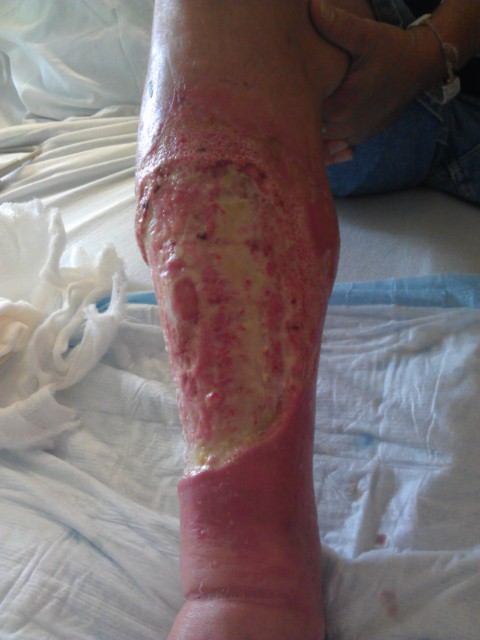
    This is what it looked like after just a day or two:

Pretty nasty, right? And I was thinking it would go away. At the clinic they wanted to know how long I'd had it and when I told them it was less than two days they could not believe it and several docs came in and began talking about taking the leg off.
   No thank you.
   I returned to the clinic for the IV three times a day for three days until the woman who owns the bar I use as my office when I'm in Iquitos--Miriam, owner of the bar El Noche on the boulevard overlooking the river--grabbed me by the hair and dragged me to her car and took me to her doctor, who turned out to be very good. He said the antibiotics I was using were not strong enough and gave me a regimen of three different drugs, along with some vitamins and probiotics to help my stomach deal with the antibiotics.
   And then four days later it was time for my second group of guests to arrive and they did and the doctor gave me clearance to go to the jungle with them. Now don't kid yourself. I was not going to do a lot of hiking with them, but I still thought it important to be there with them to explain things. And then I also took the boat ride and short walk to help collect the ayahuasca and admix plants our curandero, Jairo, was going to utilize in the medicine. And it was important that I was there when they drank the medicine to make certain they knew they were being taken care of--they had a great deal of faith in my team, and several of my team are "watchers" when people drink, but I think I lend just a touch of extra protection, maybe just because I speak English or because they know I've gone through whatever they are going through.
   Other than those occasions, though, I was just a talking head who helped out cooking and answered questions. And during the trip I kept up the IV antibiotics (with the help of a generous recently-retired anesthesiologist who changed the IV location every couple of days) and my team washed the leg with different plant--and animal--extractions daily.
    I wasn't getting better but I didn't think I was getting worse. Nonetheless, the damned thing didn't look great and by the time I came home about 15 days later--during which the doc sent me to a wound specialist for washing daily, which included lots of medicines and such--it had gone a little gangrene. This is what it looked like by the time I got home:
Well, I sent that photo and some others that Chepa, the fantastic wife/ex-wife took on the night I returned and sent them on to my doc in Alabama who told me "Good God Man!!! Get to an emergency room now!"
   I took his advice the next day and to my surprise they told me they needed to operate. When? That night. No, no, no. I left the hospital against doctor's orders and went home to explain to Chepa and Madeleina and the boys that I'd be gone a few days and what was happening and where I'd be and then I went back to the hospital. The first of two operations, called debriding, was done the following morning. We started at 7 AM with a CAT scan to see if the infection had gone into the bone--in which case amputation would be called for--and luckily, it hadn't. And the surgeon at Huguley Hospital was great. Don't know how to judge surgeons but I liked him right off the bat. I got a needle in my lower spine at about 8 AM--along with something that put me in a very foggy heaven during the operation, and when I woke up at 9 AM I was being wheeled back into my room. They showed me what it looked like at about noon. This is it after they took away the dead black and yellow skin. It's gross so close your eyes if you like.
I mean, I had flesh eating bacteria before but never never never ran into something this freaking hungry. Hell, that's about half-a-pound of meat gone!
    I spent 13 days in the hospital and had a second operation to get rid of more dead skin on the sides and back of the wound, then they sent me home. So I've been back from Peru since August 1, in the hospital from August 2 until near midnight of August 14, and in a freaking fog here at home for the last few days.
    That's my excuse for not writing and leaving you all out in the cold. The damned pain pills and the antibiotics sap my strength and I'm on the IV three hours a day--four hours including set up and clean up--then have a two hour nurse visit to clean the wound, then spend an hour getting the meds ready for the next round--hell, having this is nearly a full time job!
    By luck, my surgeon likes that I walk and so I walked--gimped to be honest, with the leg fully wrapped so as not to get more bacteria and not make people puke at the sight of it--between 2 and 4 miles daily during the last 9 days at the hospital. And I'm walking about a mile or so here at home, plus doing regular housework and cooking and such. Had a great barbeque on Sunday, for instance, with shrimp and ribs and chicken and marinated and barbequed broccoli, asparagus and cauliflower and a knock-out key lime pie that my friends Michael and Dian made--though I'm sure it was Dian who did the actual making with Michael doing the store runs to get the necessary limes and such.
    And now I'm healing. If things go well, I will keep my leg up some, rest some, live life some and after a few weeks get a skin graft. I asked them to take the skin from my stomach but they said they don't want fat so they're going to take it from my bicycle-honed thighs. Oh well, I was just trying to get in a little liposuction at the same time I'll be getting a skin graft or two.
    Since this whole thing started I've lost about 20 pounds and I'm aiming to lose another 20 so that I will be back to being thin and strong after too many years--about seven--of being a fat pig. And then I'll spend 10 years paying off the hospital bill. They said they'd be patient. Nice.
   Anyway, that's my story. Hopefully, I can get back to other things--like Marco having decided to move back in here when I wasn't looking--in the coming blogs. I just needed to bring you all up to speed. I hope you didn't mind. Cause this leg is really taking almost all of my brain space at the moment.
   Thanks for listening. Time for another hydrocodone and then another IV. Ah, the life, eh? Ain't it grand and mysterious and fantastic?

Tuesday, June 04, 2013

Getting Quality Sapo from the Frog

Someone wrote to me recently asking about the differences she has noted in different sticks of sapo--frog sweat utilized as a fantastic medicine and hunting tool by the indigenous Matses of Peru and the Peru-Brazil border area. Now in the last few years there has been quite an interest in sapo. Many people going to Iquitos are offered it and many ask where they can get a bit of it. It's not something you would do for fun: The sapo--the Matses use the same name "toad" for both the frog itself (they didn't used to distinguish between toads and frogs when they first learned Spanish, though they certainly did in their own language) and the material it gives off as its protective mechanism. The way it works is this: The frog, the phylomedusa bicolor, is a tree frog that moves very slowly and deliberately most of the time. Its primary predators are boa constrictors that live and/or hunt in trees. With few exceptions the tree snakes are venomless--there are a few rear-fanged tree snakes, but as noted, most tree snakes are constrictors with no venom. Now when the snake takes the frog into its mouth, the frog panics and in that moment of panic gives off a bit of a creamy goop called sapo. That material hits the constrictor's mucous membrane and instantly freezes the snake, giving the frog a few seconds to back out of the snake's mouth and make it's escape by jumping the hell down out of the tree.
    If that frog has recently needed to utilize it's protective sapo--or frog sweat--then there is a good chance it won't have strong enough sapo to freeze the snake and so the frog will wing up crushed in the snake's neck, on the way to the snake's belly.
    For human use, the frog is tied up to four little stakes in the ground by bits of string or plant fiber, stretched out so that it looks like a little green trampoline, and then it is badgered a bit until it gives off it's frog sweat. That frog sweat is collected by running a twig along the frog's sides, back and legs, and the material is then generally transferred to a small stick--picture a doctor's tongue depressor, and dried for later use. Once on the stick and dried it looks like yellow or gold varnish.
   To use it, the Matses will spit onto a small portion of that dried sapo, then liquify a bit of it with a knife or stick--scraping the dried sapo into the spit until it's liquified to the point where it has the texture of wasabi mustard.
   A piece of tamishi, a particular jungle vine used to tie house beams together, is then heated at one end and when red hot, the burning end of the tamishi is placed against the skin, generally near  the shoulder.  The burned skin is then scraped off, exposing the capillaries beneath. The diameter of the tamishi rarely exceeds 1/4 of an inch and is often smaller than that so generally two or three burns are required for good effect--though some Matses, during particular times of the year, might do five at a time, and some gringos looking to set world records will try more than that.
   Once the burning is done, the sapo is applied to the exposed subcutaneous skin and within about 15 seconds the acute effects of the medicine onset. Thay will include quickening of heart beat and pulse, often accompanied by profuse sweating and sometimes the urge to defecate or vomit. The extreme torture of thinking your heart will explode and feeling more poisoned than you've every felt, lasts about 15 minutes. Some people are fine after that, others are so exhausted they need to rest.
   What really happened during those 15 minutes was that your entire circulatory system, as well as your kidneys and liver, have gotten a deep cleansing. You felt poisoned because the poison in your system and the gunk on your arterial walls was flushed, huge amounts of it at once, and your bloodstream was just full of that poison.
    Once that flushing is finished--and you might wind up with some weird colored poop and piss for a couple of days--you'll find your whole body has sort of been rebooted. You see more clearly, hear more distinctly, do not get tired as quickly and a host of other things that are vital to a hunter but serve the rest of us as well. Hell, I could write a book and might, but for now that's enough.
    So this friend of mine wrote to ask about differences she's noticed in different sticks of sapo that she's acquired. mostly from my team. And this is what I wrote back to her to try to explain why different sticks would have different strengths:

B: Hmmm....to me the sapo is pretty universal IF, and this is a big IF...if the frog in question has a full load, has been running freely, and is properly collected. The variation in strength probably has something to do with the individual frog as well, just like humans have different levels of strength and so forth. 
   The keys to me are 1) collecting sapo from a frog that has not utilized its sapo in at least a week; 2) collecting the branch the frog is sitting on, rather than collecting the frog itself; 3) that the sapo is only collected from a frog living in its natural environment, not one held in a camp for repeated sapo taking.
     Collecting sapo from a frog that has not utilized it's protective sapo in at least a week is the equivalent of not milking a poisonous snake until it has not eaten in a week or so: Once the strongest part of the sapo has been utilized for defense, there will still be sapo looking substance there but it will not be at full strength, just as a venomous snake that's recently eaten will not have much power in its venom--although it will still have that liquid. 
    With more people collecting sapo these days, much of it is being collected very badly. People often hear the frog then climb into the tree and take it back to their canoe to bring to camp to milk the sapo. Problem with that is that the moment you touch the frog it gives off it's best/strongest sapo because you're terrifying it. The Matses always, and I mean without exception, either call the frog to have it come to them (actually Pablo was the only person I knew who could do that), or cut the branch on which the frog is sitting and then they bring the entire branch back to camp without disturbing the frog--which allows them to get the best/strongest sapo out of it during collection.
    Collect only from free roaming frogs: As the sapo is made as a result of what the frog eats, the sapo will only be strongly made if the frog is dining on what it likes to dine on. Some people I know keep frogs in their camp to periodically milk. They have weak sapo because while the frogs may be living in a tree and eating insects, it may not be living in its tree of preference and eating its insects of preference, which are what makes the sapo. That's also the reason that if you purchase a phylomedusa bicolor frog at an aquarium it won't poison you with its sapo: Eating crickets doesn't allow the frog to make sapo.
   One last note: As only the first release of sapo has the maximum strength, when Matses like Pablo and Alberto--whose lives depended on sapo to give them the edge when hunting and allowed them to walk for a couple of days at a time--collected sapo, they might use two or three frog's worth of sapo to make a single stick. They culled the very very best. When my team collects for me--unless I'm with them--they'll milk a whole stick and sometimes more from a single frog. Which means one end of that stick is very strong and the other end is very very weak. Tough to tell the difference visually, which is why I tend to do a tongue test on any sapo I send out these days: Just touch my tongue to both ends of the stick to insure that it's good material. If my tongue instantly tingles and my heart starts to pound, well, I've got good stuff. (You would not want to administer it through the tongue, however, because the mucous membrane is simply too delicate and burns quite easily. Plus, the sapo gets into your blood stream way way way too fast to be healthy.)
    How's that? I could be wrong but I don't think I am.

About That Lawn...

Well, the problem with getting the lawn done was that I started painting my office. Which meant that all those jungle artifacts jamming the shelves and all that art, and the vitally important medicines I have on my desk and everything had to come down and get cleaned one by one. And let me tell you, when I got stuck by a blowgun dart with curare on it, even though it was just for a second, well, made me really sick. No fun.
    And then there were the headdresses where each feather needed to be cleaned. And then the buying of the paint and new rollers and drop clothes. Then cleaning the ceiling fan, then painting the ceiling, then the walls--painting was easy--and then the clean up and then getting everything back into place. The darned project took six days--in part because I was working on a cover story and only worked on the office for three or four hours a day. And when the cover story was done, I worked on a Drug War Follies column for Skunk. Then I got the room back together.
   By which time, the grass, which had been mowed during the several days before painting, had grown to nearly a foot high in a lot of places--we'd had a lot of rain during that week--making collecting it in the mower bag impossibly difficult. I did it that way, pushing the electric mower and emptying the bag about every 30 feet for the first 1/4 or so of an acre, then gave up and just cut it without the bag. Much easier, except that I had to rake it afterward. And I have already done enough raking in my lifetime. I don't like raking anymore. Still, I had to do that for one patch of maybe 5000 square feet and another of about 6,000 square feet. Royal pain in the neck. But now I'm down to just three or four more hours of mowing and another three or four hours of raking and then I will be done again. Which is good, because the grass I mowed just in front of my house on Friday--that's just four days ago--needs mowing again--and soon, if I'm going to be able to cut and bag it, rather than rake it.
   

Sunday, May 19, 2013

The Problem with Getting the Lawn Done

The problem with getting the lawn done--except for the couple of patches we call "the wild places" because I'm too lazy to get in there and cut them--is that it leaves you open for other work. Like yesterday, with my next cover story a week away and only a column to write this weekend, I suddenly found myself renting that rug shampooing machine I've been thinking about. Of course to shampoo the rugs you have to get everything but the piano and big desk off the floors, and if you're gonna do the room where Yelena stayed and her dog pee'd some, Italo's old room, well, I figured I might as well attack the closet floor there too....And then of course, you can't shampoo until you've vacuumed three or four times, and with this being Boots' the Wonderdog's serious shedding season, that meant not just emptying out the plastic container on the vacuum every five minutes but having to wash the filter a coule of times as well.....See where this goes? There's a reason we put off work. It's because it's never a job, it's a million jobs to get ready for the job. And those are such pain in the neck jobs that it seems easier to avoid them than attack them. I mean, unless you happen to be wealthy and can hire someone to do them for you.
    So yes, Madeleina and I picked everything off the floor in four rooms. Then I attacked the floor of Italo's closet and got rid of a large garbage bag of old magazines and dirty sox and such, while at the same time found a brand new pair of rollerblades I'm sure he's forgotten about. And then we vacuumed and vacuumed and vacuumed some more and then hit the carpets with the heavy machine and by five in the afternoon were done.
   But it was still light out, and once you start, it's hard to stop, eh? So I decided I'd better paint my office. Of course, to do that required taking down 30 pieces of art and cabinets and six shelves holding hundreds of artifacts from Peru--and so that's what I'm looking at today. Art is down. Paint and supplies are here. Some furniture is in the kitchen, some on the front porch. Man, I know we'll get it and it will be fresh in here for another year...but if I do get it, I hope it's getting dark, because if there's still any light, I might find myself thinking that it would only take a little while to do the laundry room...which would be a mistake. I should never get so caught up with work that I'm able to get there...

Saturday, May 11, 2013

My Hands are Green and Wrinkled

My hands are green and wrinkled. I just used soap to try to get them clean.
Didn't work.
They're not green and wrinkled from greed and counting money,
They're green and wrinkled from mowing lawn and emptying the mower's bag and pulling weeds and there are a thousand spines in my hands and my legs
Are covered in fire ant bites.
I worked this morning from 5 AM, worked the keyboard, read the papers, answered letters,
Solved problems, or tried to, for perfect strangers.
By noon I'd had enough of it and stepped outside to the acre-and-a-half that needed mowing badly and  the electric push mower and did the work.
At two I did an interview for nearly three hours with a fascinating person who's subject of a new story but
Hated being inside while a perfect day was coming and going.
So I did what I could for my money and to change the world, then promised more talk tomorrow and disappeared to buy the cats and dogs and birds and me some food.
And reappeared to the desperate need to mow more lawn, to pull more weeds, to
See my hands wrinkled and green. To get more spines from the angry weeds and stings from the fire ants I molested.
I did, I do, I'm happy.
I love the visceral.

Thursday, May 09, 2013

Yelena Blumenau, Rest in Peace

Yelena was my late friend Daniel Blumenau's wife. I knew Daniel for years and have written about him previously. When I was in college and for some years after that, Daniel would hire his brother/my friend Phil and me to come in to do the last work at building jobs he had. And he always had interesting  building jobs: Jimi Hendrix' Electric Ladyland, Island Records' Carnegie Hall offices and their Grove Street town house, Oscar De La Renta's east side townhouse, that sort of thing.
    Well, we stayed in touch about once a year--he'd call to remind me that Phil's birthday was coming up--until about 10 years ago. Then nothing, but that was fine too. Until about two years ago, when he called to say his wife--a woman named Yelena whom I'd never met--was terminally ill with cancer and he wondered if I had any medicines from the jungle that might help her into remission. As it was, he said, the doctors only expected her to live another six weeks.
    I immediately sent off some Una de Gato--fresh vine, Cat's Claw in English--with directions on how to make it. Used forever in Peru and other parts of the Amazon basin for everything from bursitis to immune deficiency disorders, it's currently suggested as an adjunct medicine here in the US by most cancer and AIDS hospitals because of its fantastic ability to increase the T-cell count, bolstering immunity. (There's more to it, but not relevant to this story.)
    Yelena took to it fantastically, and in a matter of weeks was up and about. Unfortunately, a couple of months after Dan got in touch with me he had a massive heart attack and died. (Rest in Peace, Daniel B.)
    But Yelena, though crushed by his passing, had gotten the urge to stay alive and got in touch with me about going on one of my Jungle Intensive courses to the Amazon. I tried to talk her out of it, but when she insisted, I said okay. And so, with a large discount, she came.
    The other guests on the trip urged me not to take her out to the jungle because they thought she was too weak and wouldn't make it. I thought her spirit looked fine, and knew that my late teacher Julio's daughter Lady would be on the trip and be able to collect good medicinal plants for her--so off we all went.
    She was a delight. Started every darned sentence with "Darling..." and ended them all with "you're the best." She would walk down from her sleeping quarters to the river's edge (a small tributary of the Amazon) to bathe wearing a tiny bikini and six inch spikes. I urged her to wear the jungle boots I provided but she said they didn't make her feel elegant. So she fell, and fell, and fell. Spikes are not jungle appropriate. I let her fall until she finally switched to the boots.
    And she did everything asked of her in the jungle except, I think, one longish hike that she wasn't strong enough to make. If you saw her out there you would never have believed she was supposed to die months earlier. And when we got out of the jungle, Lady had indeed collected and prepared some medicines specific to Yelena's needs.
    And she had such a good time that she returned for the next Jungle Intensive some months later. Again, she was great and I was so proud of her.
    A couple of months later she visited my home--along with several other people who'd been on recent trips with me--for a long weekend of good food, good company and good medicine.
    Months, perhaps a year, passed, and we stayed in touch now and then, me just checking in and making sure she was making and drinking her Una de Gato and the medicines Lady gave her. She was.
    In December, however, she called to let me know she was dying. She was scared. She was having trouble going up and down the steps of the sailboat that Daniel had bought her and on which they traveled and lived for several years. She asked if she could come to my house for a little while just to be  in a different space and around my family--and particularly Madeleina--whom she'd grown immensely fond of. I was busy at the time but told her she was more than welcome to come after I got home from Peru in late February.
    And she did. But the woman who walked through the door at 3 AM (Chepa and her boyfriend Troy did the honors of the airport run) was not the woman I'd previously seen. She was very thin, very weak and having difficulty walking.
    But she was still lively and still full of "Darling's and you're the bests," and after a few days here she was gaining a little weight and asking me to go get pizza and ice cream and watching movies with Madeleina and I and even helped out in the garden now and then, and would take a chair out sometimes to sit in the sun in the back yard.
    Chepa gave her massages when she hurt--and she hurt a bit for a while as she came in using four to six Oxycodone daily and ran out after about two weeks--cold turkey with advanced cancer is not recommended or easy.
    And then, one night, she fell when she tripped on the mattress that was on the floor of the room she was using. And that was the beginning of a downward spiral. In the morning as she was explaining how she'd fallen, she and I both noticed that her stomach seemed to be noticeably swollen. I wanted to take her to a doctor but ran into red tape: As she had Medicaid in Florida, she couldn't be seen in Texas. I told doctors that we'd pay cash and they told us no, it was illegal to take cash for a visit from someone who had Medicaid, even if that was in a different state.
    It was an impossible bureaucratic hurtle, with the only solution being an emergency room, which she absolutely refused.
    Fortunately, after staying with us for a month, Medicare kicked in and the day it did we were at the cancer ward of a good local hospital. By that time she was considerably swollen, not just her stomach but her legs and feet. She was having more difficulty walking.
    The doctor at the hospital suggested--bluntly--that she would be dead in two to three weeks, and suggested she move into hospice care. She said no, she could still bathe herself and wouldn't do it. So the doctor suggested hospice care at my house. Again she refused. We left after getting a script for a pain killer much lighter than Oxycodone and a water pill to help her eliminate some of the excessive water she was carrying.
    The next couple of weeks got very difficult. As she went downhill, she became shrill. She would come into my room or go into Madeleina's room at 2 AM demanding more pain killers or that we make her hot chocolate--but in such a shrill way that it was difficult to maintain a loving demeanor. Or she would go after the pills herself, or make her own tea and leave the stove on under the empty pot. She had me buy clothes that she refused to wear, but also refused to go shopping for them with me. She had to be cajoled into leaving her room for lunch or a little walk. She was still eating well--which I took as a good sign--with two eggs or an omelete with cheese bread on the side daily, then a chicken drumstick for lunch and a small dinner of scallops and rice or swordfish. And she loved sushi. And a cup of hot chocolate at night.
    I was hoping she'd hit bottom and would start to get better, but when she didn't, we went back to the cancer center, two or three times. Each time they'd tell her they could give her stronger pain killers (she didn't want them because they made her feel foggy), hospice care or a new round of chemo. When she'd refuse those things, the doctor or nurse practitioner would ask "Then why did you come back? You know that's what we have to offer. There is nothing else."
   She had a dream of going to the MD Anderson cancer unit in Houston, but that was dashed when they told me they had no live in program: She'd get treatment, then go home. In Yelena's case that would mean getting an efficience apartment in Houston, because my home is about eight hours away and I simply couldn't move to Houston, even for a short period of time.
    A week ago Saturday, about 10 days ago, she called me into her room and told me she wanted to return to Florida. I will admit to a great feeling of relief when she said that, as what I was putting Madeleina through--and it was just about two months by then--was not fair.
    I didn't say okay. I told her that if she was serious she should ask me the following day and I'd get the ticket for her--and it was her money for these things, not mine, just to be clear. Then I called the airline and asked what the procedure was for a very ill but non-contagious person. They told me just to get her to the airport and someone would have a wheelchair and get her onto the plane and someone else would be waiting to get her off at the other end.
   The next day Yelena asked again--demanded shrilly if you want the truth--and I bought her a ticket for Monday afternoon.
   Monday was a long long day. Whether it was physical, emotional or what have you, that morning, while packing her things, she fell. And fell again. She couldn't walk to the bathroom or get her pants down when I got her there. When she was finished her business she told me to leave so that she could brush her teeth. I stepped out of the bathroom and heard a boom as she fell back against the tile wall. I called Chepa and asked her to get over as quickly as she could because I didn't think I was going to make it alone. Chepa came and we got her into my truck and Chepa wished her a good flight. I got her to the airport and the wheel chair and got her and her dog Stella booked and to the boarding line, where I kissed her and told her I was sorry that the medicines I had had not gotten her better. "They will, don't worry," she said. It was the first cheerful thing she'd said in a week.
    And then I left.
    I felt such a mixture of guilt for failing, guilt for being thrilled that she was gone, guilt at what I'd put Madeleina through that it nearly crushed me with its weight. And I prayed that she would make it home safely and that the miracle would happen.
   It didn't. She died three or four days after returning to Florida.
   I hope that her transition to the next life, next realm, next whatever awaits is a good one, one without physical constraints or pain or frustration or anger over getting ill. I hope that her spirit winds up somewhere wonderful. Have a good trip, Yelena. Your work here is finished. Rest in Peace.

Friday, May 03, 2013

Tough to Please My Daughter Madeleina

So Monday night we had about 4 ounces of Chilean Sea Bass ($23.99 a pound) each, with two sea scallops ($16.95 a pound, which is about 7-8 scallops) and two #6-10 shrimp (just 13.99 a pound, with four shrimp costing $9) on a bed of spinach sauteed with garlic/olive oil and balsamic vinegar.
   On Tuesday I made a rack of ribs with thin sliced new potatoes cooked in chicken broth and served with yellow squash and zuccini.
   On Wednesday I made sweet and hot sausage, sliced, sauteed, cooked with red pepper, onion, garlic, scallions and organic tomatoes over Basmati rice. Served with watermelon.
   On Thursday I stuffed Hatch Peppers with chopped chuck and the left over meat from the ribs and sausage, sauteed with garlic, olive oil, yellow rice, four kinds of hot peppers, onions, fresh sweet peppers and cilantro. I served that with a couple of sushi rolls I bought at a good sushi place.
   So tonight I have an organic chicken roasting with red potatoes, organic baby carrots, onion, celery and garlic in olive oil. Orange juice from fresh oranges sprayed over the dish while in the oven. Being served with a plain homemade gravy. And served with pineapple for dessert.
   So what does Madeleina say?
  "Hey dad! Why don't you ever make brisket? You never make brisket! You don't know how to cook, do you? My uncle Bruce makes great brisket! So make some, okay? Do your job and start cooking real food!"
    Okay, I'm still gonna serve her, but I'm not sure I'm gonna serve with all the love I had before she said that.....I'm a long way from perfect, eh?

One More on the Ayahuasca Dieta, then I'll Shut Up

I posted my previous post on a board I occasionally visit, and someone came back with the question of: If what I said about ayahuasca dietas being a recent invention by gringos, then how come everyone who offers ayahuasca also offers the dieta. This was my response:


I think that both the indigenous and non-indigenous in the Peruvian Amazon have traditionally lived primarily on a diet of fish and platanos--with some exceptions, like the Matses and some other groups who primarily ate meat, rather than fish. So I think if a Westerner found a curandero and had not brought his/her own food supply, that they'd soon find themselves eating fish and platano most meals. I just think that's one of the basic jungle diets. I think--and it's only me thinking here--that food restrictions come when new foods are introduced: if a person lived in an area where there were no hot peppers, for instance, but then went to a town where there was a jar of hot peppers in in lime or sidra on the table and then ate a spoonful, well, the shock of the heat and the burning of their mouth might make that person immediately swear off peppers and have them telling their friends and family not to eat them either. With something like pork, well, if it's not prepared well you can get awfully sick from it--and with no refrigeration it's easy to get sick on pig in the jungle. So I think that's another that's pretty naturally proscribed in traditional settings where ayahuasca was served.
   I think the answer to your question though, really lies more in the boom of ayahuasca drinking that's gone on over the last 10-12 years in Peru. When Francisco Montes opened Sachamama in about 1993--the first real ayahuasca center, I believe--he never talked--to me at least--about dieta. Out at his place we'd eat fruit and fish; when he came to Iquitos he'd eat ceviche with me or have a soda with lots of sugar. But by about 2003 or 2004, he'd built several tambos on his place specifically for dietaros--people on the ayahuasca diet--and was serving a pretty strict routine of boiled fish and platanos or rice. Some of those people who spent time with Francisco went on to open their own retreats, and they used the dieta as well. Then someone like Gerald at the Yellow Rose, for a joke, put up a sign that said he served The Ayahuasca Diet: No salt, no oil, no suger, no SEX! Well, at first it was a joke, but when people started ordering it, he started to make it, which made other restaurants follow suit--so that now all of the restaurants that serve gringos provide the ayahuasca diet. (As a side and snide comment I will add that I've talked with some of the retreat owners who relish the fact that by serving just cucumbers, fruit and some boiled fish and plantains they save a boatload of money.)
    So I think the dieta just sort of caught on, and that it's become a badge of courage for a lot of people. When I'm in Iquitos and people stop to talk with me, an awful lot of them tell me how many times they have had ayahuasca and how many weeks they've lived the dieta. And that's fine for them--just not something that came up in the old days when I started drinking ayahuasca.
    When it comes to my guests, I offer a lot of really good food. Lots of veggies, lots of fruit, beans daily, yucca, plantain, rice, and just a bit of chicken and fish. Like Moises, I don't want them heavy with sugar, I don't want them to have sour stomachs--though I do use tomatoes, but cooked or in lime juice--don't serve pork or red meat (no way to keep it fresh) and forbid my team from killing monkeys or birds to eat. I like them to have plenty of energy, but like it to be clean--so in my own way I sort of impose a diet on them, though they hardly think it is one when they're eating. On ceremony day though, one meal at breakfast and then nothing else till after ceremony--when they drink I want them puking up the bile of their lives, not hard-boiled eggs.

Thursday, May 02, 2013

Another Person Asked Me About Dietas with Ayahuasca

So another person asked me about dietas and ayahuasca--you know, what's proscribed in order to get to the proper state to drink the sacred medicine. And once again I found myself poo-pooing the whole freaking idea. So for those of you who have not heard it, here's my rant.


Dear X: No, I have never done the dietas. I never heard of them before 2001, which was about 17 years after I started drinking ayahuasca. I did diet, but I didn't know it was for ayahuasca: Moises never let me eat tomatoes in Iquitos before one of our hikes. Said they were bad for the stomach: Too sour. He never let me eat pork either, because it too was sour. And he said sugar made you slow for hiking and you needed to be fast for hiking, not slow. And then we'd walk six or eight days in the jungle and only eat plants or a bird or monkey we came on. 
   In terms of the dieta that people talk about, I have to laugh. If people knew Peru as it really is, they'd know that if you grow hot peppers, you grow them for sale, not to eat. And if you live on a river where they don't grow and you go to buy them, well, they're very expensive--completely unaffordable. So no, most people don't eat hot peppers.
   If you want salt, it's for preserving food, not for eating. Peruvians in the jungle, until 10 years ago when cheap Chinese motors were introduced, had to canoe 8-10 hours to any place that might have salt. You bought it to preserve fish you were going to sell, not for eating--and since you didn't grow up with it, you didn't miss it.
   No pork: Well, if you raise pigs for sale, or just for pets, you know darned well that you can't take a pork chop without killing the pig. And no one in town--again, at least 8-10 hours from where you live, by canoe--would buy a dead pig. You bring the pig in live and draw a crowd, then kill it in front of everyone. People buy pieces of the dead animal while it's eviscerated stomach cavity is still steaming. So no, no pork. But remember that wild boar is okay to eat on an ayahuasca dieta--and wild boar is the same as pork. So it's not what people think when they talk dietas at all.
    No sex. Ha! Most curanderos I have known have had multiple wives and multiple girlfriends and they love sex, whether they are 30 or 70. Julio's youngest daughter came when he was about 71 or so.
   No coffee: Julio always had a big cup of coffee with cream and lots of sugar just before ceremony--along with a great big meal loaded with the hot charapita peppers in lime that I would bring. Why? Because he'd been tending a fire while cooking ayahuasca for 10-12 hours and was hungry and loved the treat of peppers and lime and needed coffee to stay awake during ceremony.
   I contend that all these rules are made up or misinterpreted by people who don't know shit. They ask a guy who lives on a river where no hot peppers grow if he eats hot peppers before ayahuasca and he says "no", and the idiot recording him then says "On an ayahuasca diet, you don't eat hot peppers." Freaking crazy. 
   Now, what I was taught was that if you wanted to learn a plant, you went out and sat with it. You slept with your arms around it. And you quickly learned that there were stinging ants protecting it and they made it impossible to sleep with your arms around it. And if you got past the stinging ants, there were wasps on the second or third night, and maybe tarantulas/scorpions on vampire bats coming to protect that tree on the fourth night. And then maybe a couple of constrictor snakes that lived up there who came down to kill you after a week.
   And if you got past all of that, well, then the plant/tree would be more than willing to treat you as an equal and teach you things. 
   That's a tough dieta. Eating platano and fish--the favorite food of people in the Amazon--may sound tough to us Westerners, but to a person from northwestern Amazonia, well, that's like telling a fat school kid that the only think he can eat is McDonalds and ice cream. It's not a punishment or a dieta, it's a freaking favorite.
   That's my take on dietas.

Wednesday, May 01, 2013

Nice Little Surprise

Well, I just got a nice little surprise. I was looking at booking my ticket to Peru--and Madeleina's too if she wants to join me and I hope she does because she is the best company for both the guests and me that you can imagine!--and went to the American site. And guess what? They are now flying direct from DFW to Lima. They will still make me--us--come back via the police state that is Miami International Customs, but going will be direct. They used to fly direct to Lima and back to Dallas, but cut that out some years ago. Which made the trip very long: I generally get up and am out of the house by 9 AM, at the DFW airport by 10, on a flight to Miami by 11, arrive at 2:30, then wait till the 4:40 flight to Lima, which came in at 11 PM. And then the seven hour wait at the Lima airport for the flight to Iquitos at 6 AM, which arrives about 8 AM. So that's a 24 hour hell and I always arrive tired, short-tempered and such. This new flight will have me leaving my house at 3 PM, getting to the airport by 4 PM and catching a 5:55 flight to Lima that gets in a 1 AM. Through Customs in Lima by 2 AM, there will just be a four hour wait for the Iqutos flight. So it will be a full six hours shorter. That may not seem like a lot to some people, but trust me, when you're traveling with a ton of stuff--the med kit, my daughter and so forth, there is a big difference between 9 AM and 3 PM in terms of how cranky you'll be when you finally arrive in Iquitos.
    Alright, I'll admit that getting excited over that is probably an indication that I don't have much of a life. Ok, you got me.
    I still got that direct flight. Hooray! That's living, baby!

Sunday, April 28, 2013

Do participants drink ayahuasca in traditional Mestizo ceremonies?


On a board on which I occasionally post, there has been some talk of how traditional ayahuasca was utilized. Did everyone at a ceremony drink it? Did only the curandero drink it? Well, someone brought up my name and something I posted--and subsequently took down--so I sort of had to chime in. I've covered this before but I think this is a better version of what I have seen and experienced.
   It starts with me responding to someone noting that there seems to be a variation in the way different indigenous groups utilize ayahuasca.
Certainly it's an astute point that there is plenty of variation in how ayahuasca has traditionally been imbibed--the extent of which we can't really know since the Panoan language group was not a written language and only began to be one with the SIL--Sullivan Language Institute, the notorious U.S. CIA front, and before that the Office of Strategic Services front -- coming into northwestern Amazonia and writing it down.
What I was talking about was more mestizo shamanism, and even then, from my experience. With 25 or so different curanderos that I drank with in the 1980s/early 1990s, there were always locals there for healing and it was unusual for a guest to drink. With my mother-in-law and father-in-law, who both had different curanderos in Iquitos who've never served a gringo--and still haven't--it was rare for them to drink with the curandero. Ma drank at onset of puberty, then just prior to marriage and that was it, until I took her to Airport Juan Tangoa and later Francisco Montes and finally Julio to drink--but that was to help deal with very advanced cancer and she wanted guidance that she thought the plant spirit alone could give her. My father-in-law, he drank on a boast as a teen, then later when his father told him to drink at 21, and then never again (he said) until he had his legs amputated due to diabetes and he was scared to death and wanted to talk directly to the spirit.
I think Marlene Dobkin de Rios saw a similar pattern among the people who visited her father-in-law for healing as well. 
None of that goes back to pre-rubber boom time, when the indigenous still lived a much more traditional tribal life than they have at any time since. So no telling how they did it or how it varied from village to village and group to group.
And yes, Westerners are very hands-on people, so we want to know. We want to touch, taste, feel and deal with it. So we have turned the mestizo paradigm on its head. That's just what it is, and the fallout--good and bad--won't really be tallied for some time, I don't think.

Saturday, April 27, 2013

Sometimes I Don't Know if I Have Kids at All

Totally self-serving post:
Sometimes I don't know if I have kids at all,
They're all grown up and never here,
They don't come by, they don't show themselves,
Sometimes I don't know if I have kids at all.

I raised them to be independent
And I'm proud that they can get by on their own
But I never imagined that I taught them that
They never need to come home.

To see how the house they were raised in is,
To see if dad needs a hand,
To ask for eggs over easy and rice for breakfast]
Or just to tell me how they are.

Sometimes I don't know if I have kids at all,
Did I really raise them since they were that small?
Did I teach them independence in a way that was wrong
Sometimes I don't know if I have kids at all.

I just want to see them grow.
I just want to see them know,
I just want to see them being fantastic,
I just want them to learn to be elastic
To deal with this difficult world
I don't know if I have kids at all.

I never meant they shouldn't come by the house,
I never thought they should avoid me,
I always thought they would take care of this place
Where they were grown, where they were grown.

Sometimes I don't know if I have kids at all,
I always thought we'd do something together,
I guess I was slow and they moved on,
But still I thought we would be together.

This is a bad imitation of the song I was just singing on the front porch swing. I love my kids, but sometimes I don't see them for a couple of weeks, not until they need a college paper tweaked or a car payment made. And that's probably my fault. I probably trained them to be very self-dependent. But I never meant they shouldn't come by a few minutes every day to tell me what is going on in their lives or how they're doing. That's what's making me sad tonight: That I pushed independence too far and now they want to prove they don't need me. And that's sad for me. Period.

Wednesday, April 17, 2013

Sad Day

I have a column in a good dope magazine, Skunk. You should all go out and buy it just to show support. They use my old cohorts at High Times, Steve Wishnia and Bill Weinberg, two of the best drug war journalists ever, plus let me have the column, so I'm a fan.
   Today I turned in my new column. It won't show up for six weeks, but we're intimate friends, here, right? So I'm gonna share it with you and if it's over the top, stupid, whatever, well, then I'm over the top and stupid. But this was what I was thinking about today, two days after the Boston Marathon Bombing.


SKUNK MAGAZINE
DRUG WAR FOLLIES

The Boston Marathon Bombings and the Puppet Masters


By Peter Gorman


Well, the world is suffering today. As this is being written, the FBI, bomb squads and a host of other law enforcement groups are working their asses off to try to find who blew up the people at the Boston Marathon. The death toll as of this writing is three, though by the time you read it that number may be higher. It was a vile, horrific thing visited down from hell on innocent people out celebrating the human body and its fantastic abilities. And yes, we have seen similar scenes all over the world. The United States has been responsible for thousands of them. Crazy people have been responsible for many of them. Military leaders, would-be martyrs on suicide missions for their gods regularly blow up innocents at markets all over the Middle East, sending body parts and burned flesh to nestle among the fruits and vegetables for sale.
   All of it is wretched beyond imagination. If people who committed these actions had only taken a moment to realize that the innocents who are maimed, who die, who leave their families with holes in them that will never be healed, that those people they are going to kill are not the problem. The puppet masters are the problem. The people who take not just a larger share of the cake then they should but take millions of shares of the cake, leaving the rest of us to fight it out over the crumbs—and leaving people angry and frustrated and starving and crazy because there really isn’t enough if someone takes almost all of it.
    The puppet masters can then rile those people into a frenzy, pointing fingers of blame at anyone different, claiming those are the people who have taken all the cake. Those are the enemies. Those are the people starving your children. And they back their positions up with books they claim were written by the hand of their gods to justify the vilification and slaughter of those enemies.
    Hundreds of blacks were hung from trees and lampposts by poor people convinced that those blacks were taking what should have properly been theirs. The genocide in Rwanda in 1994 saw the poor Hutu people convinced that the Tutsi people intended to enslave them and once riled enough, the Hutu’s slaughtered more than 500,000 Tutsis in just about 100 days. In truth, it was just the puppet masters controlling the strings out of desperation for power, control and wealth. It’s always the puppet masters taking too much, leaving too little for the poor to share and then pointing fingers. If they didn’t take so much there would be more than enough to go around. We can grow enough rice and wheat for everyone to eat. We can grow tomatoes and garlic and potatoes and spinach and share fish and apples and melons—if only some people weren’t taking the lion’s share for themselves.
   I don’t want to get all religious on you here, but I was raised Catholic—altar boy and everything, and no, I never met a priest who was out of line sexually. One of the stories I liked best was the loaves and fishes. In that one, Jesus of Nazareth finds himself on a hill with thousands of people there to listen to him and whoever else was on the bill. But nobody hired any vendors and so people got hungry and angry then, as the story goes, Jesus of Nazareth got hold of a couple loaves of bread and a few fish and began distributing them and he never ran out. It was called a miracle, that he could multiply food like that.
   I never really believed that was a miracle. If he had superpowers then it was an easy thing for him to do. But I did think a miracle occurred. In my little kid’s mind I pictured that when people got hungry and started to get antsy and angry, that Jesus of Nazareth, without superpowers, simply looked out over the large crowd and probably told them that if everyone shared all the food they had with no holding back, then there would be plenty for everyone. And I always pictured people slowly bringing out their stash—some with enough food for 20, others with just a couple of figs—and beginning to share until it got contagious and all the food came out and then yes, there was plenty for everyone. Because there always is if people share.
    But there are those who don’t share, people who never have enough. Who would rather let the bread go stale and the fish rot before they’d give it up to the next hungry guy. And those are the people who point the finger at someone a little different and tell the hungry person that that other person is responsible for their hunger. And then, well, someone decides they ought to blow up strangers watching a marathon.
   It’s a sad day. It’s a sad day every day because every day someone is pointlessly killing someone else at the urging of the puppet masters who need to deflect their responsibility before they are seen for what they really are.
   I was thinking about the bombings at the Boston Marathon—just two days old at this minute—and wondering who had convinced someone, the person or persons responsible that by hurting, maiming, killing strangers the scales would be in better balance. It wasn’t necessarily a particular person personally convincing someone to do the deed, it just needed to be a seed implanted that grew to the point where the horror looked like the best solution to the person making the bombs.
   I was also thinking about how many people were frightened so badly by the puppet masters when people started smoking a lot of marijuana and dropping copious amounts of LSD that they allowed and even encouraged laws to be enacted that criminalized a huge swath of the population. The politicians couldn’t act on their own, so they needed to convince the non-pot smokers that the pot smokers were bad. More than that, evil. More than that: Evil and they were going to get your son and daughter to join in their evil and be like Charles Manson and so they needed to be locked up. And to lock up all those people a couple of million new prison beds were going to need to be built. And the non-pot smokers believed it and went along with it and so millions of people wound up in the criminal justice system—emotionally maimed, scarred, sometimes forever.
    They are the same puppet masters. It wasn’t done with bombs or machetes or drone strikes, but it tore a nation apart and allowed those puppet masters to deflect from the real horror of what they were doing, from raping the environment to starting wars for oil. Taking not just a bigger portion, but nearly the whole damned cake.
    People of Boston: Peace
    To those who died there and who die needlessly every day: Rest in Peace. Maybe the rest of us can work to see that less killing, less hurting takes place tomorrow.
   

My Daughter Insists I'm in the Closet

Madeleina insists I'm in the closet and should come out openly gay. She may be right, but as long as I get erections looking at my ex-wife and other women, and don't when I look at my man pals, well, I'll probably stay inside. Still, today she was talking about having to present a poem to class. Not one she wrote but a poem by someone else. I reminded her that we have a small collection of maybe 60 books of poetry that include some of the very best poets--not all well known at all--of the late 20th Century, as well as a number of other books and collections from different eras.
   Then she surprised me and said her all-time favorite poem was one I wrote. I couldn't remember it--I used to write a lot of poetry--and asked her which one it was. She laughed and said it was one that I'd told her I wrote for a friend in college who came out of the closet and asked my friend Phil and I--along with a couple of others--to watch and march with him in the annual 5th Avenue Gay Pride Parade, probably in 1970 or 1971.
   Then I remembered it. Here it is, and the only reason I'm sharing it is because my baby loves it. And that makes me proud.

Ideal love
Created above,
Is not enough
To keep us here
From going queer.

Let's get the marriage thing done, people. Equality works. Inequality never works.

Tuesday, April 16, 2013

Hard choosing a good dinner....

Okay, so we've got a very very ill person staying with us for the last two months. We're doing the best we can but even good medicine and prayer will only get you so far. Nonetheless, people have to eat. So today our guest asked for a toasted english muffin with cream cheese and stawberry jam, with coffee and half-and-half (organic) and her jungle medicine and American meds.
   Then she wanted left over lamb stew with Mediterranean spices--lots of organic carrots/potatoes and just a tiny bit of grass fed organic, expensive lamb.
   Today, I was finishing a story, going back and forth with my editor who was questioning everything I wrote, and I was trying to figure out what would be the best dinner. I have some really good swordfish and was thinking of that. But then I imagined that maybe Italo, who was off today, might come over today. And since I didn't have enough swordfish, I thought I might make that and then also make some hot sausages with sweet red and green peppers, onions and tomatoes over rice--cooked with garlic in olive oil, of course.
   But then Madeleina had asked for Sushi, so I bought her what they call a San Antonio roll around here and I bought a salmon roll for me. Which the guest ate. And then, since the kids are coming, I threw on some chicken legs and rice.
   So now we've got swordfish with peppers and capers on a bed of spinach, some sushi, chicken with rice and sausage with peppers and onions. Plus we've got left over lamb stew.
   Who'd hungry? Come on over. That's way too much to eat if my kids don't show up.

Saturday, April 06, 2013

There's Something Wrong with Me, Dad

So I was facing and getting through a huge pile of dishes and pots this morning. A huge skillet in which I'd cooked three days worth of chicken legs for Boots the Blind Wonderdog and little Stella, a cute pup who came with my friend Yelena, seriously ill with cancer, to stay at my house last month. Then there were the pots in which I'd cooked elements of last night's stuffed manicotti (the spinach and garlic pan, the sausage pot, the zuccini pot, the pyrex dish in which the manicotti went, the pot in which I'd made the tomato sauce and so forth. Then the actual dishes, glasses and silverware attendant to that meal. Then there were Yelena's extra things--maybe eight glasses and cups and a couple bowls of left overs. Madeleina had threatened to wash it all this morning but didn't. Still, as she walked out of Yelena's room with the cups, glasses and bowls (which were in addition to her plate from the manicotti which she had while we all watched Seinfeld reruns), Madeleina noted: "Dad, I'm sorry I didn't do the dishes. I really should have."
   "You're not sorry, Madeleina. You had no intention of doing the dishes."
   "You're right. And it's the easiest thing to do. You're going right through them...but still, what's wrong with me that I just won't do housework?"
   "I think it's called teenage-itis..."
   "No, I'm serial, daddy-o. Something is just wrong with me. Of course, if something is wrong with the child you can bet it's the parent's fault. So way to go, dad. You messed me up. Why'd you do that? And look what you get for doing it: You have to clean the whole house and do the laundry and cut the lawn--karma, dad. It's a beotch, isn't it? If you ever have more kids, try not to screw up so badly, okay?"

Friday, April 05, 2013

Calling All Togoans!

Okay, so Madeleina is impressed that my blog has been read--according to the stats the blog keepers keep--by people in more than 100 countries around the world, some of them pretty tiny, like Kuwait and Curacao, others pretty large, like Russia, Brazil, Cameroon. And she likes the sound of Mauritius, Myanmar, Zimbabwe, Trinidad and Tobago, Gabon, Oman and Bosnia and Herzegovina. But she says this blog will never be anything, "won't count for jack, dad, until you have Togo! That's what will count! That's when you know you've made it. Until then, you're a loser, dad. Just face it, loser."
   Well, given that her 16th birthday is coming up on April 9, I'm gonna cheat here and send out the word to all my fans in Togo to start reading this blog. Let's bury the little bit.....would I actually call my beautiful daughter that? HA! So if you're out there in Togo-land, which is a West African country about the size and shape of a piece of spaghetti, well, start reading and make my daughter proud of me, okay? That's what this is about, making my daughter proud of me.
  P.S: Don't tell her about this blog entry or she'll say it doesn't count. She's a stickler that way...

Thursday, April 04, 2013

Women curanderas? Why not more of them?

Someone wrote to ask if there were any female curanderas. I wrote that yes, there are, but then gave a very brief and abbreviated history of why there are not more of them. This is what I wrote:

Dear X: Certainly there are female curanderas. I work with Adela Nevas sometimes, and the indigenous Shipibo women rule the roost at a number of lodges. And there are others. 

   What you need to understand is this: The whole concept of curandero comes from someone in a given indigenous village--often the headman at a small village, sometimes someone else at a larger village--who know the plants and animals and can communicate with them to learn when and where and what to plant, when to go to war with the neighbors, where to hunt, how to heal, etc. That role generally went to a male because the males were the hunters who were out in the bush, while the women tended camp, gathered food, raised babies, cooked and so forth. It was pretty set, duty wise, in most of the villages I knew back in the 1980s and early 1990s before they had so much outside influence and more modern tools which changed the lifestyle from hunter/gatherer with a bit of agriculture to primarily agriculture with a bit of hunting/gathering. 
   And when I say "raising babies" what I really mean is that often a first wife of a curaka--headman at camp or hunter with multiple wives--would be the wife who went hunting with him. She carried/carries the animal back from a hunt, leaving the hunter free to continue hunting if he finds more game.
   The second wife--frequently the first wife's sister--ran the village (if it was small) or oversaw a large section of it if it were large. The third wife generally had the responsibility for gathering, sometime with a fourth wife, and the last wife breast fed and was responsible for primarily raising all of the wives' children.
   Now I only knew a couple of men who had that many wives--Papa Viejo and Pablo--though I know a great many with two or three. It's basically the same set up but with duties that overlap when there are fewer wives.
   Given that as an anthropological point of view, it would generally fall on the curaka to be the one in communication with plants and animals--though often his first wife, out hunting with him daily for the whole family--could do it as well. But the job of curandero fell to the man.
   My late teacher Julio's daughter Lady knows more about healing and plants than almost anyone I ever met. Why? Because Julio used to have her go get the plants he needed for curing--and she learned very well. She could do ceremony in a heartbeat if she would allow herself to imagine she could. But I don't think she ever would, as that falls to the males and Lady is pretty traditional that way.
   Don't misconstrue however: In my eyes most of northwestern Amazonia is a matriarcal society, and the curaka, while he looks like the boss, is really beholding to the several wives and couple of dozen kids he has. If he stops hunting sufficiently, the women will just make him poison soup and be done with him. Then they'll head off in search of a new man who is willing to hunt for everyone.
   Lady, for instance, allows my friend Juan, her husband, to be the boss--in public. But get them alone and she is in charge.
    Given all that, the women I've known who were willing to take the mantle of curandera were very very strong.
More than you needed?

Wednesday, April 03, 2013

Ayahuasca Bitch-Slap Explanation, sort of..,.


Someone wrote to ask me what the heck I meant when I said ayahuasca--the jungle medicine--needed to be bitch-slapped a little. I used a coarse term--I apologize--but went on to explain that what I meant was that the spirit of ayahuasca had gotten a little too big for her britches lately and just needed to be reminded that like all of us, she's a component of the universe, not the universe.
   Interestingly, the guy wrote back that similarly to when I had been ordered by the spirit of ayahuasca to "bring me fresh meat"--which included me bringing myself to the medicine in a "fresh meat" state, with no alcohol, no over-tiredness, no cutting corners in my personal preparation--he had recently been asked by what appeared to be the spirit of ayahuasca to spread the word about her, to get more people to drink her. So I thought on that a little while and then wrote him back. And I think it's worth sharing, at least in this intimate blog way.
    This is what I wrote:
Well, it's interesting: since I first wrote about ayahuasca asking me to bring her "fresh meat" in my book I've taken a lot of heat. Some people think that's just insane, or that I just made that up--but you cannot make this stuff up, it just happens, and what happens is more outlandish than anything I might make up.
   But then there were notes from others as well, like yours just now, telling me that similar queries or demands were made on them too. To bring more people, to spread the word and so forth. And I think a lot of the people who have opened lodges have done so because they had a "vision" that they were supposed to bring more people to the medicine.
   Now, whether it's sinister or not becomes the question. I actually think the medicine is very generous, very decent. On the other hand, I also think that ayahuasca is sentient--which would include having a will, desires, intention. And I think anyone/any sentient thing can get priorities mixed up if they suddenly find themselves pushed into the glare of the spotlight. How many actors go crazy after they become stars--when they were apparently quite normal prior to stardom? How many curanderos come to work for lodges and get big heads about their personal powers and so forth, when prior to the lodge work they were humble people living the very plain life of a local curandero on a river or in a shanty town in Iquitos?
    So why couldn't ayahuasca get swell-headed as well? After all, for hundreds--perhaps thousands--of years she's been working in obscurity among indigenous and later mestizo farmers and fishermen. Suddenly, in the last 15 years, she's all the rage, not just in Iquitos, but in Europe, the US, Canada, Australia. Could that tweak an ego a bit? I think it could. And I think so many people being asked or told to bring more people, more fresh meat, to her is an indication of that. 
     I do think that because she's basically so good that her instincts will win out fairly quickly and she will become humble again. I think the deaths, mostly by suicide, but a couple sort of inexplicably at different lodges, by people associated with Ayahuasca--though its doubtful that ayahuasca had anything to do with them--has shown her that along with superstardom comes unfillable expectation. You want to be the star? Then you take the heat. And I think she's aware of that and would not want the association with negativity, and so will reel herself in a bit.
    I also think that when someone/some spirit becomes a superstar, lots of other people/spirits are going to cling to that person's coattails. And so it may not be ayahuasca herself who's asking  you/me to bring more people. It may be the hangers-on that are doing that, who enjoy the superstardom charge and want more of it. If that's the case, then she will have to shuck them--they're probably not her real spirit friends anyway.
    This making sense?

Tuesday, April 02, 2013

Drug War Follies Column That's Not Going to Run

Well, I got my Drug War Follies in late to Skunk Magazine in February and so it didn't run. Darn it. But I am not going to have wasted all my time, so here it is for you. Enjoy.


Drug War Follies

U.S. Customs, drug dogs and the High Court; the DEA pats itself on the back despite remarkably uneven sentencing and the GEO Group flashes its cash and arrogance. Ah, ain’t life in the drug war a bitch?

By Peter Gorman


So it’s Springtime. You got your gardens in yet? Well, what are you waiting for, me to come up there with a plow? Get them in now so that I’ve got good smoke the next time I come back from Peru in July, okay? That’s right. Think of Peter Gorman and his need of good smoke and get yer asses out there and plant those outdoor babies cause I don’t like that indoor tea. Not one bit. I mean, think about a nice outdoor Blueberry or Purple Haze sitting there in the sunlight in your back yard. Or an old fashioned California Orange, smells so good you think you can squeeze orange juice out of the leaves. Now you’re thinking.
    Speaking of just coming back from Peru, well, I just came back. Took a nice small group out into the deep jungle where I had them walking in swamps, eating shrooms on an overnight riverboat ride on the Amazon, teaching them about jungle medicines, serving them ayahuasca and having some indigenous Matses friends of mine provide them with the Matses’ medicines sapo and nu-nu. Then up to the mountains and more shrooms and finally to Machu Picchu where they all drank the magic elixir San Pedro—a cousin of the Southwestern peyote.
   It was a great trip, at least till I got back to the U.S. Customs station in Miami. Normally I get there and I’ve got my luggage packed with my medical supplies, a few clothes and lots of food: Things my ex-wife and my kids, all born and partially raised in Peru, love to have, and things you can’t get here. There are certain types of peppers we don’t have in the northern hemisphere, and the limes are very different, and there are dried yucca bits called farina and spices and herbs and salt fish and all sorts of things I have to bring back or my family wouldn’t let me come home.
    Typically I spend an hour at Customs arguing over the legality of what I’ve brought back, whether it’s magic shrooms or regular shrooms, hand rolled cigarettes, whatever. “What’s this?” I’m asked, and then I tell the agent and they go look in their book to see if it’s legal and either let me have it or throw it away. Last July they got me good: A newbie who was probably on his first month on the job and he was tossing every thing I had, from jungle medicines, to dried fish to cigarettes—all legal, but you can’t really argue the case with a federal agent. When they’re done, you go.
    Things were different this time out. I filled out my form—How much money you bringing? Where have you been? And so forth, and I circled the item asking if I was bringing in any food. So I’m on line waiting to get my passport stamped so I could go get my things and get ripped off by Customs when this little beagle comes and sits down next to me. “You have food, Mr. Gorman?”
    “Yes, I wrote that I did. I also have jellybeans in my shoulder bag. I guess that’s what the beagle is smelling.”
    “Follow me.”
    “Where and why?”
    “Shut up and follow me.”
     He had the gun, I followed. I wasn’t brought to my luggage like I thought would happen. No. Instead I was brought through two heavy doors to a room filled with maybe 60 people—some of whom I recognized from my flight—and told to sit down and be quiet. I asked what was going on and was told to be quiet and wait. So I waited maybe two hours, missed a connecting flight home and still no one called my name. All the agents there, including a female who had tossed a lot of my stuff a few years ago, looked like they played middle linebacker for their high school football teams. All buff, no fluff, loaded pistols at their sides. No one would talk to anyone. All of us, or most of us, had just come in from Peru or Bolivia and we’d all been traveling nearly 24 hours, so this was an uncomfortable wait.
    Finally someone at the back of the room called my name. I went out into a hall where two agents, one behind a desk at a computer, the other near the exit door in case I decided to bolt, stared at me.
   The one behind the desk says: “You brought food again? You’ve been busted before. Several times.”
   “I know. But that’s because you keep changing the rules. One year I can bring in limes, the next year I’m fined for bringing in Limes. This time I checked. I put the lime juice in bottles with the hot peppers—the pepper seeds are killed by the lime juice, my ex gets her hot pepper sauce, I’m legal. What’s the problem?”
   “You brought food again?”
   “Yes. I wrote it on the Customs’ form.”
   “What food?”
   “The hot pepper sauce. Kitchen spices. Something called farina that’s made from yucca…”
    “What’s yucca?”
    “It’s like a Peruvian potato. It’s a tuber.”
    “So why don’t you say potatoes?”
    “They’re not potatoes. If I tell you potatoes and the farina doesn’t taste like potatoes you’re gonna say I was lying.”
    “What else?”
     I went down the list.
    Absolutely certain I was lying, we went to get my bags and they had me put them through the X-Ray machine. Then they had me open them. All four of them, including my shoulder bag with the jellybeans. Guy puts on rubber gloves and sticks his finger into the open jellybeans to see if they’re really jellybeans. “Well that’s ruined,” I note to myself.
    One by one he goes through everything. “Those are mushrooms?”
    “Yes. My wife likes to cook with them.”
    “We don’t have mushrooms here?”
    “Not like these we don’t,” I said, and smiled when he dropped them back into the kitchen spice bag.
    Half-an-hour we play back and forth with my shit until the agent declares it all legal and lets me pack up.
    “Will we be doing this same dance next time I come through or can you write a note on the computer that I was clean?”
    “Have a nice day, Peter.”
    I walked out thinking that if a person notes that they’re bringing food into the country on their Customs form there ought to be a better way to handle it. I mean, you can assume they’re being honest and do it the old way: Just check the luggage. Damn, we make it easy to dislike the U.S. government, I thought, just as Neil Young’s line from Rockin’ in the Free World came to mind: “We got a kinder gentler machine gun hand”.
    Okay, okay. There was a point to that story. It started with a beagle, right? So here’s the segue: On February 19, the U.S. Supreme Court overturned a 2011 Florida Supreme Court decision that ruled that law enforcement agents had to do more than claim a drug sniffing dog had been properly trained before that dog’s hit on a vehicle would permit a full search.
    The Florida Supreme Court ruling held that simply training a dog in a controlled environment did not prove that the dog would be capable of sniffing drugs in a vehicle in the field. Which is reasonable: Lots of ball players look great in practice but can’t hit for dink during the games. But the Supremes, in all their wisdom, saw it differently, condemning all of us who travel anywhere in the U.S. to be subject to a search of everything we have in our vehicles at the whim of a dog, who might just be excited about a ham sandwich he’s sniffed.
   Damn, we make it easy to dislike the intrusive U.S. government, don’t we? “We got a kinder gentler machine gun hand.”
Over on the DEA’s official website, justice.gov/dea, they always tout their latest and biggest busts. Over there this morning, among other things, was the story of a Canadian smuggler convicted in a California court who was sentenced to 81 months in a federal lockup. He’d been busted with 66-pounds of methamphetamine and more than $125,000 in cash while in the process of buying six kilos of cocaine. He was also convicted of conspiracy to move Ecstasy, working with drug trafficking organizations and so forth. And he got 81 months.
    But then the very next story on the DEA site dealt with several people indicted for growing pot in seven  homes in Elk Grove and Sacramento, CA. Yeah, they had nearly 3,000 plants and 100 pounds of clean pot but they are each facing possible life in prison.
   Now, I don’t want anybody going to prison for non-violent drug offences, even if it involves meth. But given the state of the world, wouldn’t you think someone would notice that something is wrong when 66 pounds of meth, six kilos of coke and involvement with cross-border smuggling over a long period of time is gonna get you under seven years and fucking pot growing is gonna get several people possible life? Goddamn I am so sick of this bullshit where pot growers are getting hit harder than other drug dealers. And then I think of Dana Beal and all the time he lost sitting in a cell for a little pot, and Mark Emery paying his pound of flesh and all the rest of us who have suffered and suffer so freaking pointlessly just so the man can keep the prisons full and the GEO Group investors happy. The GEO Group—the private prison giant—which just recently bought the rights—for $6 million—to have the Florida Atlantic University football stadium named after the company.
    You get that? A private prison company specializing in detaining non-violent illegal immigrants and non-violent drug dealers gets the Federal and state governments to pay them billions to incarcerate people, then uses $6 million its got hanging around to have a football stadium named after itself.
Only in the good old USA, boys and girls. Only in the USA.
It would all be funny if people weren’t dying and the prisons weren’t full.